
The Ten Bulls

Distraction – Seduction
Dis-traction. Being drawn away. That which leads you away is se-ductive. The promise you believe, the seductive gravitational pull is what you grant to drag yourself away. Distraction is normative and existential. It matters (existential) and shows what matters (normative). Distraction is being drawn away from something which is of priority, while seduction is giving in to temptation, to the self-perpetuative pattern you acquired. Seduction is not imposed from outside. It is subtle. One wills their own seduction.
I think when you have [an] addiction, you want to do something that harms you. […] because it’s control. It’s like I want to control how I feel. […] It’s like things feel so hectic right now, at least if I damage myself, then I’m the one doing it, I’m not just letting the world do it. - Theo Von1
Everyone has their way of being seduced, of taking in the blade of avoidance in order to numb oneself. This seduction can grow into the desire of being lacerated by it. This blade may be forged by abusing drugs, porn, behaviors or all of those and more. The edge of the blade is sharpend by every pull given in.
Control. Being in possession of methods for achieving a known outcome, a psychological place. 2 Those worn paths of willful seduction are such methods. Whatever you achieve by them, you want them, even if not in their entirety. You may be attached to the familiarity of despair, which you can summon by command.
If being aware of something is based on contrast, then this distractive seduction is fed by the attempt to substitute your current present state for something else which you can enforce. Your present is clothed into the fabric of utter rejection, that which you can’t accept. Seduction promises to lead you away,3 makes you believe that you can escape. The possibility and success of seduction builds on unhealed wounds and faith in the will, which operates by force and control. Seduction builds on the inability to stay with the present. The biggest seduction: the delusion of being able to escape.
Distraction is only the superficial symptom of being already enchanted by the song of seduction. Seduction in turn is not something which forces itself onto you, it uses no violence. The gravity of seduction exerts its pull only through the fissures of your self. The song of seduction reaches your ears through the space you allowed to be open, your eardrum reverberating with the sirens’ song. This breach of your self is not an opening in the way of acceptance, it’s exactly contrary to that: This space is held open by keeping a foot in the door in order to escape. Absolute acceptance, existential nakedness, would erase seduction in it’s entirety. Waking up and carrying your cross, being ready to be crucified without any second thoughts. Being utterly human, a psychological naked human without “Hintergedanken”, without hiding behind a mask.
I was ashamed of myself when I realized that life is a masquerade party, and I attended with my real face.4
Seduction tells you that you can escape what you are right now, that you can cheat yourself. This attempted escape numbs your present moment, fleeing into ever increasing heights of distraction and pretense. The thing you think you need is projected out of the state of non-acceptance. The need to escape is self-sufficing and self-referential, as it rationalizes why you should escape and what to escape to is based on the will to escape. Those ancient paths treaded into the woods and fields of being.5
You don’t attempt becoming a special being beyond your situation. The attempt to achieve something beyond yourself, burning incense or chanting buddhas name, is still distraction from what you are right now. Don’t get lost in the attempt to become someone or something different. Don’t let yourself give in into the seduction of believing that you can leave your rejected parts behind once you “get” the truth. Neither grasp nor reject your thoughts, let them come as they wish. Just sit. Zen begins and ends with you, with your mind, your paths, your desires, your wounds. Zen lets you figure out that if you are able to let everything be as it is, there is no conflict, that everything comes and goes by itself, that you are only controlled by the battles you think you have to fight. This radical openness surrenders the controller and lets them be seen as a fiction of the verbal mind. But you must not want to let everything be as it is in order to get awakened, enlightened or at peace. In that attempt there is still the controller active. It begins with searching for something that you have lost and and ends by recognizing that it never actually was.
The 10 Bulls
Where do we begin? Where do we end? Zazen. If you sit and let everything be as it is, you are already there. Being fully and solely your present is the realization of the immanence of holiness.6 If you can let yourself truly sit, just sit, there is no struggle, no pretension, no seduction, no distraction. This you can’t do willfully, nor control. It is not a space you can travel to by will. Zazen teaches a wholly different attitude. An attitude which you can’t take but which takes everything. Just sitting means relinquishing any control whatsoever. This attitude is described as dying on your cushion. You have to let go of the will, of the intention itself.
Shinkantaza. Just sitting. Once you sit, you are realizing what you are without arriving at something which you can grasp and stop at. This sitting is not something »you do«. There is no method for it. Lack of a foundation. Openness without a center.
Then one night during sitting meditation in the latter part of the night, Rujing came into the hall and admonished the group for sleeping, saying, “Zen study is a matter of shedding body and mind. It does not require incense burning, prostrations, recitations of Buddha names, repentance ceremonies, or scripture reading. You accomplish it by just sitting.” Hearing this, Dogen was suddenly enlightened.(Keizan & Cleary, 1990, p. 223)
The 10 Bulls are a beautiful image for that. The 10 images are symbols for a seeker, seeking for enlightenment. The seeker begins by searching a bull which has gone astray, attempting to capture it.
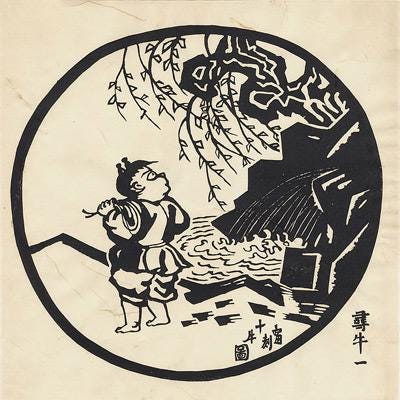
On the journey, slowly the seeker gets some hints of the bull. She may see its traces, recognize its smell, step into its excrements.
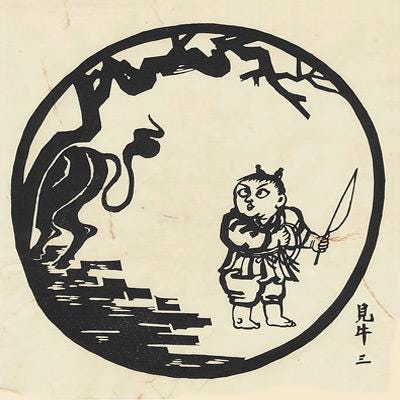
After a while, the seeker captures the bull and brings it home again.
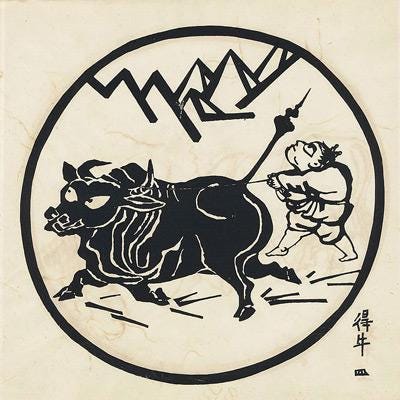
Arriving home both are tired and rest. The journey comes to an end, realizing that the bull was never really away
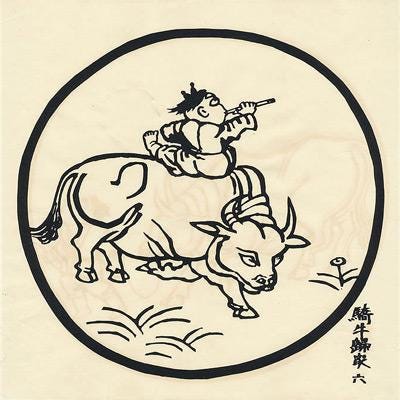
.
Tai-an of Fu-chou asked Pai-chang, ‘I wish to know about the Buddha; what is he?’ Answered Pai-chang, ‘It is like seeking for an ox while you are yourself on it.’ ‘What shall I do after I know?’ ‘It is like going home riding on it.’ ‘How do I look after it all the time in order to be in accordance with [the Dharma]?’ The master then told him, ‘You should behave like a cow-herd, who, carrying a staff, sees to it that his cattle won’t wander away into somebody else’s rice-fields.’(Suzuki, 1949, p. 370)
References
Keizan, & Cleary, T. F. (1990). Transmission of light: Zen in the art of enlightenment. North Point Press.
Merleau-Ponty, M., & Smith, C. (2006). Phenomenology of perception: An introduction (Repr). Routledge.
Suzuki, D. T. (1949). Essays in zen buddhism (first series) (C. Humphreys, Ed.). Rider & Company.
Heidegger uses the word “Stimmung” to signify that we are not beings which understand their worlds primarily by reason, but by attunement. Translations swallow their connotations. Stimmung is used in different contexts: Stimmung as mood, Stimmung is also used when talking about a music instrument. To tune an instrument is to say you “stimmst” the instrument. Also to say that something “stimmt” is saying that something is correct, reverbereates with the same frequency. What Heidegger says is that we are basically “Befindlichkeit”. Befindlichkeit means: ontologically one finds oneself always in a world into which one is thrown. Ontically, we are thrown into a world out of which we project our self, we neither know where we came from nor where we are heading. But as a Dasein (Heideggers word for being a human) we are always concerned with our being, our possibility to be, which is being-thrown-into-a-world (Geworfenheit) out of which we throw us further (Entwurf). Ontically attunement (Stimmung) discloses a world for a Dasein before rational grasping. One example of his is anxiety: being anxious discloses the world before rational understanding and this anxious disclosement is not one superstructure projected onto meaningless matter, but being showing itself unreduceable as this anxious meaningful whole structure.↩︎
Se-duction. Latin ducere: to lead, to drag.↩︎
The quote is attributed to Franz Kafka. Sadly I can’t find the exact source. It may be falsely attributed, but nevertheless it drives the point home.↩︎
After writing this I realized that what I wrote here is in the same lane of phenomenology as Merleau-Ponty understood it. This quote makes it obvious: “The phenomenological world is not the explication of an a priori being, but grounding/establishment of being. Philosophy is not the reflex of an a priori truth, but akin to art: Realisation of truth. […] Philosophy means to learn anew to see the world. Therefore a simple story can be as deep as a philosophical inquiry.” For me it depends on the mood which kind of philosophy seems salient. On days like these the existential orientation of phenomenology beats in the same pattern as my heart.(Merleau-Ponty & Smith, 2006, p. XIII)↩︎
I do not, in no way whatsoever, want to imply the dogmatic notion of holiness of christian theology. Holiness here means becoming whole in the same way meant as in my first Essay.↩︎